You have heard what peptides can do. Maybe you came across a peptide while researching weight management, recovery, healthy aging, or another wellness goal and wanted to learn more.
Then you start shopping, and you notice something strange about this industry. Everyone seems to be selling them. A friend of the family. Your trainer. Somebody's office manager. Peptides have moved quickly into places medicine does not usually live, and the sheer number of people offering them can make it difficult to know what you are actually buying.
Somewhere in that process, you pick up a vial and read the small print.
"For research use only. Not for human consumption."
What "For Research Use Only" Actually Means
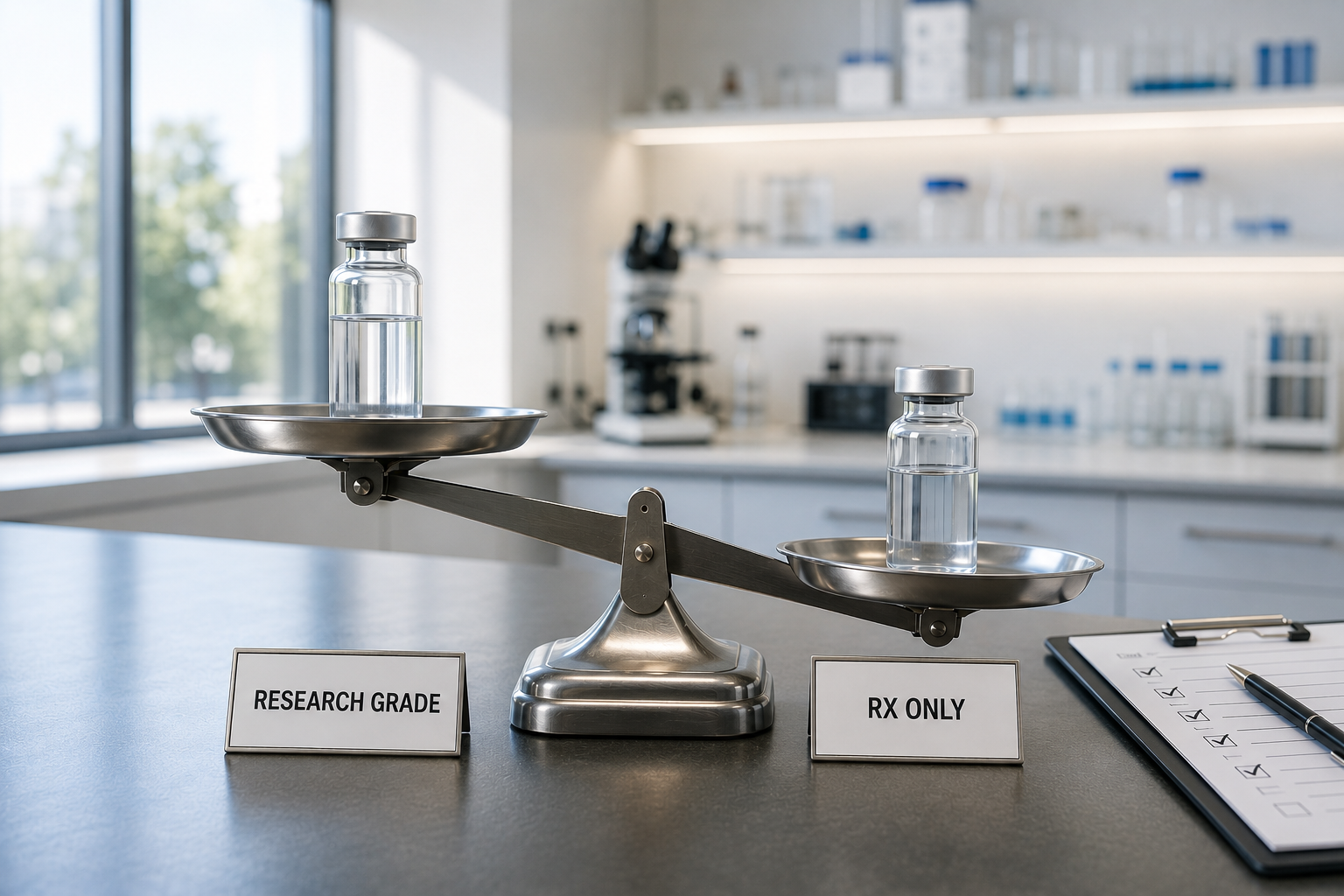
You may see this statement on peptides sold by research chemical companies and other vendors whose products are not intended for human use. The label is intended to identify a product as being sold for laboratory or research purposes rather than for human use.
Here is why it is there.
Products intended for human use are subject to drug laws and regulatory requirements that do not apply in the same way to products legitimately sold only for laboratory research. FDA-approved drugs undergo FDA review for safety, effectiveness, and quality. Compounded medications are different: they are not FDA approved, but pharmacies that compound them must operate within applicable federal and state requirements.
So the disclaimer is a shield, and it protects the seller. You are being told, in writing, that this was never approved for you to use.
That is worth pausing on, because the language points the wrong way. "Research grade" sounds like a higher standard. But it actually describes a product sitting outside the system that would otherwise check it.
Are Research Peptides Safe?
Let us be straight, because the marketing in this space muddies the water. You will see claims about a lab in California, or a facility in Italy, and those claims are there to help make the product feel closer to home and easier to trust.
The real question is not simply where an ingredient was manufactured. It is the regulatory and quality framework surrounding the ingredient and finished medication.
When a 503A pharmacy compounds from bulk drug substances, federal law places specific requirements on the ingredients that may be used. Bulk drug substances must meet applicable requirements, be accompanied by a valid certificate of analysis, and be manufactured by an FDA-registered establishment.
A research vendor carries none of that. They may buy from an excellent facility. They may change suppliers between batches and never mention it, because nothing obligates them to.
Same possible origin. Different obligation to prove it.
A Certificate of Analysis (COA) Helps, But It Verifies Less Than You Think
A vendor who provides a COA is offering useful information about the product and the testing that was performed.
But a COA only tells you what was actually tested and reported. A purity result alone does not establish sterility, endotoxin levels, correct concentration, or how the product was handled and stored before reaching you. It is also important to know whether the testing can be reliably tied to the specific lot being sold.
Worth reviewing. But a COA alone does not provide the same oversight and accountability as a prescription medication filled through a licensed pharmacy.
The Doubt That Comes With Research Grade Peptides
If you are reading this, you probably already have a version of this feeling.
You are putting something in your body every week. Something from a category of medicine that is still new to most people. And underneath the price comparisons is a quieter question: do I actually trust this?
With a research vial, that question never fully closes. You can read the certificate, check the reviews, buy from a vendor people speak highly of, and still be holding some doubt. Not because the product is necessarily bad. Because there is no way to find out.
That doubt is a real cost. It never shows up in the price comparison, and it is often the thing people are actually paying to be rid of.
How Above Wellness Approaches Pharmaceutical-Grade Peptides
Above Wellness does not sell products labeled for research use only. Peptide therapies offered through Above Wellness require a prescription from a licensed provider and are filled through licensed U.S. compounding pharmacies.
503A compounding pharmacies must comply with applicable federal and state requirements governing the ingredients used in compounded medications, including requirements related to eligible bulk drug substances, certificates of analysis, and FDA registration of bulk drug substance manufacturers.
Your medication travels from that pharmacy to you. No distributor in between, no repackaging step, no chain of resellers.
You will not receive a certificate of analysis with your order, and that is by design. The verification happened upstream, documented by a licensed pharmacy that answers for it. You are not being asked to audit your own supply chain.
Four things change when a prescription is involved:
- Someone reviews your health history and current medications before anything ships, because these are not right for everyone.
- The pharmacy has to document where its ingredients came from and that the facility is FDA-registered.
- Sterile compounded medications must be prepared in accordance with applicable sterile compounding standards and pharmacy requirements.
- There is a provider to call when something feels off and you are not sure whether it is normal.
Obtaining a prescribed compounded medication through a licensed healthcare provider and appropriately licensed pharmacy provides a different level of oversight and accountability than purchasing a product labeled for research use only.
Choosing Peptide Therapy You Can Actually Trust
At the end of the day, there is an important difference between a prescription medication prepared within a regulated pharmacy system and a product sold with a label stating that it is not intended for human use.
If price is what decides it for you, just know what comes with it.
If what you want is to stop wondering or being concerned, then a prescription is the best path.
See some of the peptides we carry, each one prescribed by a licensed provider and filled by a licensed pharmacy.
This article is for general education and is not medical advice. Peptide therapy is not right for everyone. Compounded medications are not FDA-approved and are not reviewed by the FDA for safety, effectiveness, or quality. Talk with a licensed provider about your own health history before starting any treatment.